Uzbekistan
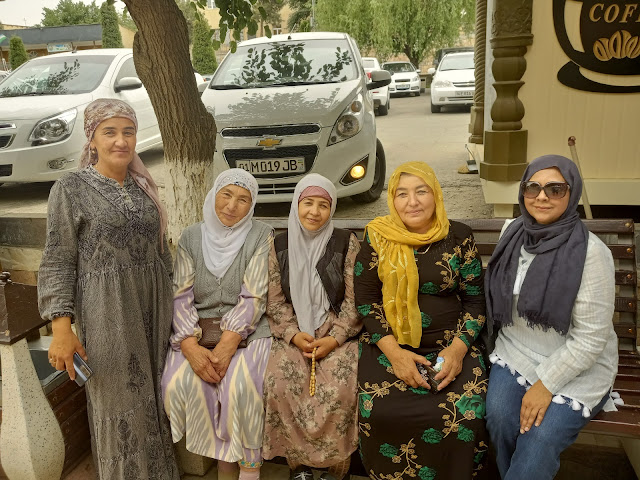
I enjoyed my May 3-13 Gate 1 trip to Uzbekistan in Central Asia. It is a long ways away, one of the 5 alliance"stans." I flew from Salt Lake City to Seattle, then a 15 hour flight to Dubai, and another 4 hour flight to Tashkent (directly north of Kabul, Afghanistan), the large, modern, prosperous, multicultural capital. Until Independence in 1991, Uzbekistan was one of 15 republics of the USSR, thus most of its 31.8 million people speak Russian and Uzbek. Because the people are such a mixture of Turk, Mongolian, Iranian, Korean, Russian, Chinese, European, and more, the culture is rich and diverse, the people are beautiful, friendly and the young people eager to practice English and especially to have their photo taken with visitors.


The bold dots mark the places we visited: Tashkent, Urgench, Khiva, Bukhara, Samarkand. Although 90% of the population is Muslim (Shia, Sunni, Sufi, etc.) there is freedom of religion; some observe halal ("kosher"), some women wear hijab (head coverings), others do not, though they generally wear long dresses with long sleeves. This mostly desert country is dotted with beautiful mosques, madrasas (Islamic schools), and mausoleums all decorated with blue/turquoise tiles. In Tashkent we visited the Museum of Applied Arts with beautiful textiles, miniature paintings and other artifacts
Tashkent has beautiful buildings (the above Forum Palace is the site of many international meetings). Below is the Russian Theater, and nearby is a Japanese Theater. The Russians built wide streets, huge buildings, and destroyed many of the traditional buildings and culture, but the Uzbeks do not seem to feel animosity towards them, but rather appreciate the development of education, jobs, organization. 98% of the population is literate. Many of the utilitarian and unattractive Russian buildings are being torn down and traditional sites restored. There are many internationally acclaimed universities.
Until 2011, Tashkent had the only metro in Central Asia. It is efficient and each station has a theme such as "cosmonauts." Apparently I unknowingly took these photos, forbidden because it is considered a military installment!
Restaurants are elegant. Our group of 20 Americans was very diverse (by birthplace), including 6 Pakistanis, 2 Iranians, 2 Chinese, 1 Filipino, 1 Spanish, 1 Vietnamese. We were a living example of the diversity of America and were a surprise to locals and other tourists.
500,000 died and 200,000 buildings were destroyed in the devastating 1966 7.0 earthquake, with an epicenter in Tashkent. Volunteers came from everywhere. It was decided in 2016 to divide the city into a fully rebuilt modern part (tearing down the old soviet structures), and to preserve and rebuild the traditional. The Monument of Courage commemorates the brave local men and women.
The Abu Bakar mausoleum, built on an old cemetery, is a lovely tribute to an important 10th century imam. Some of his students' tombs lie at the entrance.
Next door to the old Kast Imam mosque (below) 20,000 prayed on the square, 5,000 in the madrasa (on the right), a new mosque, which can hold 25,000, is being built. 50,000 will then be accommodated.

School children at the observatory in Samarkand celebrating May 9, end of WWII. The Uzbek flag : blue (eternal night and water= life force),12 stars (12 bridges), green (nature), 2 red stripes (those who died), white (peace)
Lands controlled by Tamerlane
Guri Amir, the final resting place of the great Turco-Mongol conqueror, Tamerlane, in Samarkand, his capital until the capital was moved to Tashkent ("stone city" so called because of all the minerals), both cities strategic along what became known in the 1800's, as the "Silk Road"
Tashkent has the huge Chorsu Bazaar, where I bought an ugly dress and tee shirt in case my suitcase never arrived (it finally did just before we were to fly to Urgench; I had to take a taxi at 1 AM to the Tashkent airport to see if it was there)
From Urgench we traveled by bus to two old fortresses built in the Khoresm oasis (cotton also rice and wheat-growing) district between the two main rivers, Amudarya and Syrdarya, by Zoroastrians (Bactrian civilization) to protect themselves from invaders along the trade route, 2BC -2AD. This large desert area of western Uzbekistan is very hot in summer, and freezing in the winter. U. produces oil, but gas for heating is scarce (imported from Russia and Kazakistan), so many chose to build fires and live outside rather than in their houses in the last winter of 2022-3.
We enjoyed lunch at a western table. Uzbeks generally sit to eat, relax, play games at a tapchan, sitting on the platform like this one at the Ulli Khvoli complex, a caravanserai built by Turkmen people in the 16-17th centuries.
We drove on to the ancient city, Khiva , where I had a comfortable room at the lovely Asia Khiva Hotel. During dinner we were entertained by a typical tambourine, mandolin, accordion, castanet, singing and dancing group.
The walled city of Khiva was built mostly in the 18th c. by invaders from Iran, and was brutally conquered by Russians in 1876. Previously during the 8th-9th centuries, Khiva, Bukhara and Samarkand enjoyed a golden age along the main trade route from Xi'an, China, to the Mediterranean: Damascus, Constantinople, Antioch.
The "Silk Road" began in 130 BC by China and ended when Europe dominated trade and sea routes were opened. Trade was cut off from China in the mid-1400's by the Ottoman Empire.The architecture inside the walled city of Khiva is gorgeous!
Everyone wants to take photos with westerners!
Student artists painting the distinctive Kalta Minor Minaret;
Rita, Sultan and Razia
Our young tour manager Bek in a typical fur hat in the Juma Mosque with 213 columns (X-XVIII centuries, no longer in regular use)
The textiles and tiles are beautiful everywhere. Pomegranates (life, prosperity) are a popular motif
Sarwat and Nadeem Mian (born in Pakistan) and other Muslims in the group helped us understand Islam. Weddings (like our tour manager Bek's, coming up in July), will include modern and traditional dress and customs.
On our very long drive through the Kyzylkum Desertto Bukhara we passed markets and orchards and fields of fruit trees (apricot, plum, cherry, etc.) wheat, vegetables, and cemeteries. There is so much agriculture, irrigated by the main rivers that flow into the Aral Sea (really a lake) which is drying up...a disaster! Electricity is a problem, managed by turning off the power during certain hours, and one day per week. . Yellow pipes carry gas; blue, water.
In and around Bukhara
Bukhara, 2500 years old, one of the most important ancient cities, dates back nearly 1000 years before Alexander the Great conquered Central Asia. It is a beautiful, vibrant, touristy city
Everywhere we ate lots of tomato, onion, cucumber, beet, and eggplant salads, bread, shish kabobs, rice, strawberries and cherries

Pilaf is the national dish but we only ate it twice, as it was always sold out!
The Ark Fortress, former residence of the emirs of Bukhara
There used to be 100's, but there still remain many ponds
Chor Minor, an abandoned madrasa
We visited the Sitorai Mohi Palace, country residence of the last Emir of Bukhara, Alim Khan. I befriended two friendly Russian girls whom I kept running into! And lots of squawking peacocks!
Back in Bukhara we enjoyed a dance and fashion show
Quite the baby cradle
Intricately and beautifully carved Ismail Samani Mausoleum
We watched beautiful silk and wool carpets being woven mostly by young women. It takes 4 months, 8 hours/day for this size!
Poyi-Kalon ("at the foot of the Great One") mosque and madrasa complex, large enough to hold 10,000 people. Minaret is 45.6 meters.
Life in Bukhara
On the way to Samarkand (2500 years old), considered the most romantic, and perhaps best known of the "Silk Road" cities, we stopped to visit many interesting sites, always with friendly people.

Old acropolis hill outside the city of Samarkand, being excavated now, has the Museum on Afrosiab with amazing colorful murals.
Amazingly preserved mid-7th century"Hall of the Ambassadors"mural of the New Year's Procession of the Zoroastrians. At the end is animal sacrifice. King Varkhuman reigned. Gifts were being brought to him.
The Old Testament prophet Daniel passed through this old acropolis hill city in 7th century BC. Some of his bones are buried in this mausoleum, an important pilgrimage site for Jews, Muslims and Christians.
We watched the fascinating process of silk/mulberry paper. Mulberry bark is stripped off, the wood soaked, boiled, mashed, spread out and smoothed into sheets. Even dolls are dressed in it. All natural dyes are used.
An award-winning ceramics workshop in the family for 8-10 (?) generations
The huge Registan Square in Samarkand, world famous symbol of Central Asia, is surrounded by 3 impressively-decorated madrasas of the 15th to 17th centuries.
With Rita Kilgore and Phuoc Babcock
Abul and Shamima
I had a hard time resisting this beautiful tablecloth...no room!
Maria and Hassan, Phuoc and Masoud (the two Iranian men became good friends!)
I enjoyed talking to this English teacher and her students
Sarwat Mian, Shamima and Abul Rahman, Nancy and Greg Heinzen
The Bibi-Khanym mosque (XIV-XV) the largest, built by Temur (Tamerlane) to honor his favorite wife, is fraught with legends
The Siab market next door is very colorful!
Thom, Bryce, Christina and Patricia
Last lunch (pilaf) in Samarkand, before flying to Tashkent (1 hr flight)
After a nice swim in the hotel pool, a glance at the new soccer stadium across the street, and good-bye to a country full of white Chevrolets assembled in Tashkent. People have to pay tariff on imported cars. Good-bye to gogeous mosques, friendly people, safe streets, lots of schools (all numbered). We enjoyed a farewell dinner. I left the hotel for the airport at 1 AM for a 4:05 AM, 30-hour trip home to Utah. It was grueling, but I am grateful to have learned more about a not well known but fascinating country on the other side of the world. I loved Uzbekistan!
Bek took good care of us, and we made many good new friends
Because Emirates Air serves the Muslim world, the 5 times daily prayer times are posted on the airline seat monitors. I flew Tashkent to Dubai to San Francisco to Salt Lake City (about 28 hours travel time)
I got homesick as I flew into San Francisco and over blue Lake Tahoe
But I was delighted to see my garden had transformed itself in 2 weeks from brown dirt to lilacs and other flowers and trees blooming, and green grass. We still have snow on the surrounding mountains, but spring is here and regular life goes on!


 Pilaf is the national dish but we only ate it twice, as it was always sold out!


